Dense city centers support less evolutionary unique bird communities than sparser urban areas
Morelli Federico; Reif Jiri; Díaz Mario; Tryjanowski Piotr; Ibáñez-Álamo Juan Diego; Suhonen Jukka; Jokimäki Jukka; Kaisanlahti-Jokimäki Marja-Liisa; Møller Anders Pape; Jerzak Leszek; Bussière Raphaël; Mägi Marko; Kominos Theodoros; Galanaki Antonia; Bukas Nikos; Markó Gábor; Pruscini Fabio; Ciebiera Olaf; Benedetti Yanina
https://urn.fi/URN:NBN:fi-fe2025082785248
Tiivistelmä
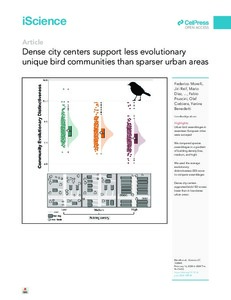
Urbanization alters avian communities, generally lowering the number of species and contemporaneously increasing their functional relatedness, leading to biotic homogenization. Urbanization can also negatively affect the phylogenetic diversity of species assemblages, potentially decreasing their evolutionary distinctiveness. We compare species assemblages in a gradient of building density in seventeen European cities to test whether the evolutionary distinctiveness of communities is shaped by the degree of urbanization. We found a significant decline in the evolutionary uniqueness of avian communities in highly dense urban areas, compared to low and medium-dense areas. Overall, communities from dense city centers supported one million years of evolutionary history less than communities from low-dense urban areas. Such evolutionary homogenization was due to a filtering process of the most evolutionarily unique birds. Metrics related to evolutionary uniqueness have to play a role when assessing the effects of urbanization and can be used to identify local conservation priorities.
Kokoelmat
- Rinnakkaistallenteet [29335]