Introduction
Hollsten, Laura; Rytty, Suvi; Latva, Otto; Lillbroända-Annala, Sanna; Räsänen, Tuomas
https://urn.fi/URN:NBN:fi-fe2025082789895
Tiivistelmä
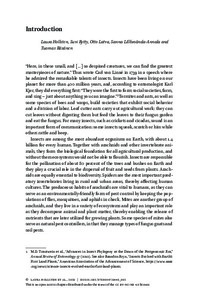
Insects are among the most abundant organisms on the planet. Together with arachnids and other invertebrates, they form the biological basis of all agricultural production and ecosystems cannot thrive without them. The global decline of insect populations and the spread of certain disease vectors to new areas reflect how bugs are affected by and entangled in the threatening and debated global environmental changes often referred to as the Anthropocene. Despite a growing awareness of their role in the survival of the living world and human culture, insects and arachnids are often popularly considered in terms of social, cultural and economic factors. They have been judged as either good or bad, useful or harmful, beautiful or disgusting. And while bugs of all kinds have preceded, co-evolved with and lived alongside humans, influencing social and historical developments as co-agents, human relationships with them have remained rather under-researched in the humanities and social sciences. However, global problems such as the loss of biodiversity cannot be solved by science alone. They are related to human behavior, which is guided by social and cultural values and conventions, as well as political and religious ideas. We therefore need deeper and more nuanced insights into human encounters with bugs.
Kokoelmat
- Rinnakkaistallenteet [29335]