Cancer immunotherapies transition endothelial cells into HEVs that generate TCF1+ T lymphocyte niches through a feed-forward loop
Hua Yichao; Vella Gerlanda; Rambow Florian; Allen Elizabeth; Antoranz Martinez Asier; Duhamel Marie; Takeda Akira; Jalkanen Sirpa; Junius Steffie; Smeets Ann; Nittner David; Dimmeler Stefanie; Hehlgans Thomas; Liston Adrian; Bosisio Francesca Maria; Floris Giuseppe; Laoui Damya; Hollmén Maija; Lambrechts Diether; Merchiers Pascal; Marine Jean-Christophe; Schlenner Susan; Bergers Gabriele
https://urn.fi/URN:NBN:fi-fe2023020726018
Tiivistelmä
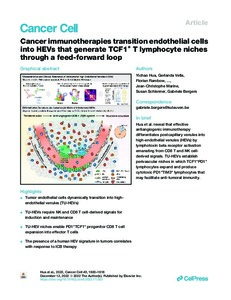
The lack of T cell infiltrates is a major obstacle to effective immunotherapy in cancer. Conversely, the formation of tumor-associated tertiary-lymphoid-like structures (TA-TLLSs), which are the local site of humoral and cellular immune responses against cancers, is associated with good prognosis, and they have recently been detected in immune checkpoint blockade (ICB)-responding patients. However, how these lymphoid aggregates develop remains poorly understood. By employing single-cell transcriptomics, endothelial fate mapping, and functional multiplex immune profiling, we demonstrate that antiangiogenic immune-modulating therapies evoke transdifferentiation of postcapillary venules into inflamed high-endothelial venules (HEVs) via lymphotoxin/lymphotoxin beta receptor (LT/LTβR) signaling. In turn, tumor HEVs boost intratumoral lymphocyte influx and foster permissive lymphocyte niches for PD1− and PD1+TCF1+ CD8 T cell progenitors that differentiate into GrzB+PD1+ CD8 T effector cells. Tumor-HEVs require continuous CD8 and NK cell-derived signals revealing that tumor HEV maintenance is actively sculpted by the adaptive immune system through a feed-forward loop.
Kokoelmat
- Rinnakkaistallenteet [29335]