Early insulin fibril detection: Insulin fibril research and TR structural transition detection with FRET-Probe
Malakoutikhah, Morteza; Kauppi, Laura; Mäntylä, Kalle; Härmä, Harri; Kopra, Kari
https://urn.fi/URN:NBN:fi-fe2025082792247
Tiivistelmä
Background
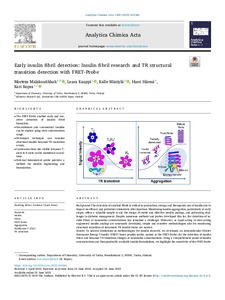
The detection of amyloid fibrils is critical in production, storage and therapeutic use of insulin due to impact on efficacy and potential cytotoxicity after injection. Monitoring insulin aggregation, particularly at early stages, offers a valuable insight to aid the design of stable and effective insulin analogs, and addressing challenges in diabetes management. Despite numerous methods and probes developed this far, the detection of insulin fibers at nanomolar concentrations has remained a challenge. Moreover, as rapid-acting or slow-acting engineered insulin analogs are constantly developed, simple and sensitive methodologies also for monitoring structural transition of hexameric TR insulin forms are needed.
Results
To address limitations in methodologies for insulin research, we developed an intramolecular Förster Resonance Energy Transfer (FRET) based peptide-probe, named as the FRET-Probe, for the detection of insulin fibers and hexamer TR transition changes at nanomolar concentrations. Using a comprehensive panel of insulin concentrations and therapeutically available insulin formulations, we highlight the sensitivity of the FRET-Probe in insulin fibril detection at early stages. In a comparative study with thioflavin T (ThT), we demonstrated 15-fold improved sensitivity of the FRET-Probe, and its ability for early insulin fiber detection. In addition, we demonstrate the ability of the FRET-Probe to differentiate between insulin hexameric forms (T6, T3R3, and R6), in the presence of anionic ligands and phenol derivatives. Thus, the FRET-Probe provides an unprecedented tool for characterizing structural dynamics using a luminescent external probe.
Significance
The FRET-Probe provides a simple and sensitive method for insulin fibril detection, enabling significantly improved detection of especially early insulin aggregation events, in comparison to ThT. The FRET-Probe also provides valuable insights into insulin analog stability and function, enabling insulin hexamer conformational measurements in real-time. The FRET-Probe can give comprehensive perspective on insulin behavior in varying conditions, thus supporting the insulin engineering and formulation processes.
Kokoelmat
- Rinnakkaistallenteet [29335]