Slow-lived birds and bats carry higher pathogen loads
Xu Yanjie; Laine Veronika N.; Meramo Katarina; Santangeli Andrea; Poosakkannu Anbu; Suominen Kati M.; Gaultier Simon; Keller Verena; Brotons Lluís; Pulliainen Arto T.; Lilley Thomas M.; Lehikoinen Aleksi
https://urn.fi/URN:NBN:fi-fe2025082790734
Tiivistelmä
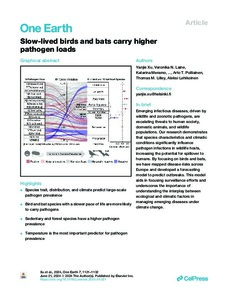
Wildlife and zoonotic diseases are increasingly impacting human society, the food chain, and wildlife; therefore, proactive mitigation tools for predicting large-scale risk of the relevant pathogens are urgently needed. Birds and bats are large-scale disease reservoirs and transmitters. However, holistic understanding for which bird and bat species act as reservoirs for pathogens remains understudied. Here, we test the extent to which the features related to the mobile species and local climate identify reservoir hosts for the 18 most-sampled pathogens across Europe. Species with slower pace of life (i.e., larger bodied and longer lived), sedentary species, and forest species had high pathogen prevalence. Temperature was the most important predictor for pathogen prevalence, but its effects varied in different directions. Overall, host species traits and climatic gradients robustly predicted pathogen prevalence, especially for non-vector-transmitted pathogens. We offer a data-driven basis for developing targeted interventions to mitigate impacts of zoonotic diseases, particularly in the face of climate change.
Kokoelmat
- Rinnakkaistallenteet [29335]