Osteocalcin and frailty among older women
Paulin, Tine Kolenda; Malmgren, Linnea; Bartosch, Patrik; Ivaska, Kaisa K.; McGuigan, Fiona E. A.; Akesson, Kristina E.
https://urn.fi/URN:NBN:fi-fe202601215532
Tiivistelmä
Background
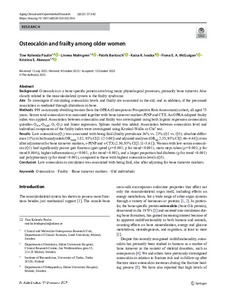
Osteocalcin is a bone-specific protein involving many physiological processes, primarily bone turnover. Also closely related to the musculoskeletal system is the frailty syndrome.
Aim
To investigate if circulating osteocalcin levels and frailty are associated in the old, and in addition, if the presumed association is mediated through alterations in bone.
Methods
999 community-dwelling women from the OPRA (Osteoporosis Prospective Risk Assessment) cohort, all aged 75 years. Serum total osteocalcin was measured together with bone turnover markers PINP and CTX. An OPRA-adapted frailty index was applied. Association between osteocalcin and frailty was investigated using both logistic regression (osteocalcin quintiles Qlow-Qhigh; Q1-Q5) and linear regression. Splines model was added. Association between osteocalcin level and individual components of the frailty index were investigated using Kruskal-Wallis or Chi2 test.
Results
Low osteocalcin (Q1) was associated with being frail (frailty prevalence 36% vs. 23% (Q1 vs. Q5); absolute difference 13%) in both unadjusted (ORunadj 1.82, 95% CI[1.12-3.00]) and adjusted analyses (ORadj 2.55, 95% CI[1.46–4.44]); even after adjustment for bone turnover markers, s-PINP and s-CTX (2.50, 95% CI[1.11–5.61]). Women with low serum osteocalcin (Q1) had significantly poorer gait function (gait speed (p = 0.001; p for trend < 0.001), more steps taken (p = 0.003; p for trend 0.004)), higher inflammation (p < 0.001; p for trend < 0.001), and a larger proportion had diabetes (p for trend < 0.001) and polypharmacy (p for trend < 0.001), compared to those with highest osteocalcin levels (Q5).
Conclusion
Low osteocalcin in circulation was associated with being frail, also after adjusting for bone turnover markers.
Kokoelmat
- Rinnakkaistallenteet [29335]