Female mountain gorillas can outrank non-alpha males
Smit, Nikolaos; Robbins, Martha M.
https://urn.fi/URN:NBN:fi-fe202601216921
Tiivistelmä
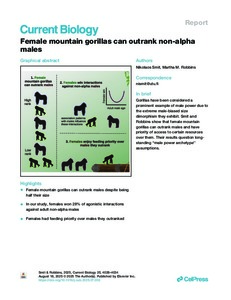
Males have been long assumed to strictly outrank females in all but a few mammals, potentially due to male-biased size dimorphism emerging from male-male competition and female mate choice. However, recent work questions these traditional views, suggesting that intersexual power varies along a continuum from strictly male-to strictly female-biased and is not a static species attribute. We used a 25-year dataset to examine the intersexual power dynamics in wild mountain gorillas, considered a prominent example of strict male power. Although the highest-ranking individual in each of the four study groups was male, 88% of females outranked at least one adult male in multi-male groups. Females won 28% of agonistic interactions against non-alpha males, predominantly when these males were young adults or old. Our results did not support that females gain power over males due to mating-based leverage, as a byproduct of male-male competition, or due to female-female support, but they suggested that females may gain power over non-alpha males due to alpha male support and by leveraging commodities not directly linked to mating. Females always had feeding priority on a valued monopolizable resource over non-alpha males they outranked and, in half of the cases, over non-alpha males overall, highlighting a functional component of female empowerment. Our study questions the "male power archetype" assumption in a hominid that exhibits extreme male-biased sexual size dimorphism and, thus, it calls for future work to investigate similar long-standing assumptions regarding the evolutionary origins of intersexual relationships across species.
Kokoelmat
- Rinnakkaistallenteet [29337]