Extracellular vesicles bearing vimentin drive epithelial-mesenchymal transition
Parvanian, Sepideh; Coelho-Rato, Leila S.; Silva Santos, Michael; Sultana, Giulia; Venu, Arun P.; Devre, Pallavi Vilas; Modi, Mayank Kumar; Eriksson, John E.
Extracellular vesicles bearing vimentin drive epithelial-mesenchymal transition
Elsevier Inc.
Julkaisun pysyvä osoite on:
https://urn.fi/URN:NBN:fi-fe202601217337
https://urn.fi/URN:NBN:fi-fe202601217337
Tiivistelmä
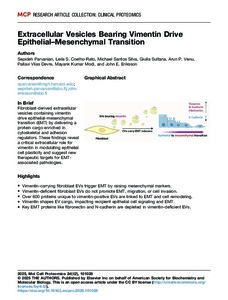
Epithelial-mesenchymal transition (EMT) is a key biological process in physiological and pathological conditions, spanning development, wound healing, and cancer. Vimentin, a key cytoskeletal intermediate filament (IF) protein, is an established intracellular determinant of EMT. Recently, extracellular vimentin has also emerged with important functions, and we demonstrated that vimentin from fibroblast-derived extracellular vesicles (EVs) promotes wound healing. Building on these findings, we explored whether extracellular vimentin regulates EMT.
We employed fibroblast-derived EVs to assess their EMT-driving capacity. Using co-culture models and EV treatments from wild-type and vimentin-knockout fibroblasts, we observed that fibroblasts induce an EMT phenotype in epithelial cells, marked by elevated mesenchymal markers and reduced epithelial markers. EVs from vimentin-deficient fibroblasts showed a decreased EMT-inducing capacity and failed to stimulate cell cover closure, underscoring vimentin’s critical role in orchestrating these processes. Co-culturing epithelial cells with wild-type fibroblasts mirrored these outcomes, while vimentin-deficient fibroblasts produced similarly poor EMT induction.
Proteomic profiling revealed that wild-type EVs contained an enriched set of EMT-associated proteins, including those involved in cytoskeletal organization, cell adhesion, and EMT-regulating signaling pathways. Notably, these proteins, such as fibronectin and N-cadherin, were significantly diminished in vimentin-deficient EVs. Moreover, we identified over 600 additional proteins uniquely present in WT-derived EVs, with enrichment in key biological processes like wound healing and cell migration.
These findings demonstrate that vimentin-positive EVs drive EMT by transmitting a specific protein cargo that supports EMT-related cellular changes. The vimentin-positive EV proteome will help understand EMT mechanisms and develop targeted therapies for pathological conditions related to abnormal EMT.
Kokoelmat
- Rinnakkaistallenteet [29335]