Mildly elevated liver lipid content is characterised by reduced insulin sensitivity
Tuomola, Nelli; Rebelos, Eleni; Latva-Rasku, Aino; Bucci, Marco; Immonen, Heidi; Saunavaara, Virva; Laine, Saara; Sjöros, Tanja; Garthwaite, Taru; Raiko, Juho R.H.; Fernandes Silva, Lilian; Virtanen, Kirsi A.; Hannukainen, Jarna C.; Ala-Korpela, Mika; Kalliokoski, Kari K.; Heinonen, Ilkka H.A.; Nuutila, Pirjo; Honka, Miikka-Juhani
https://urn.fi/URN:NBN:fi-fe202601217354
Tiivistelmä
Background & Aims
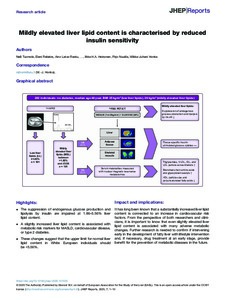
Recently, a new cut-off of ≤1.85% was proposed for normal liver lipid content based on a large population trial. In that study, people having liver lipid between 1.86% and the currently used magnetic resonance spectroscopy-specific upper limit of 5.56% had lower insulin sensitivity (higher homeostatic model assessment for insulin resistance [HOMA-IR]) when compared with people with ≤1.85% of liver lipid. We aimed to build upon these findings by evaluating differences in tissue-specific insulin sensitivity between individuals having low (LL; ≤1.85%) or mildly elevated (MEL; >1.85% and ≤5.56%) liver lipids.
Methods
Combining data from previous studies, 202 White European individuals without diabetes were included in this cross-sectional study. Liver lipids were measured with magnetic resonance spectroscopy. Endogenous glucose production (EGP; N = 96) was measured by hyperinsulinaemic–euglycaemic clamp combined with [18F]fluorodeoxyglucose positron emission tomography, and adipose tissue insulin resistance by the product of fasting free fatty acids and insulin (N = 197). Serum metabolites were measured using nuclear magnetic resonance metabolomics (N = 152).
Results
The MEL group had higher EGP during hyperinsulinemia (2.7 [-0.4; 7.5] vs. -0.2 [-4.3; 5.3] μmol/kg/min, p = 0.041) and higher adipose tissue insulin resistance at fasting (28.4 [16.6; 37.5] vs. 17.6 [9.6; 26.9] pmol/L × mmol/L, p = 0.037) compared with the LL group. In addition, serum triglycerides and branched-chain amino acids were elevated (false discovery rate <0.05) compared with the LL group.
Conclusions
People with MEL had lower hepatic and adipose tissue insulin sensitivity and adverse changes in metabolites when compared with people with LL. These findings support a lower upper limit for normal liver lipids in White Europeans. In addition, the data indicate that impaired suppression of EGP during hyperinsulinaemia and insulin resistance of lipolysis are early features in the cascade of systemic insulin resistance.
Impact and implications
It has long been known that a substantially increased liver lipid content is connected to an increase in cardiovascular risk factors. From the perspective of both researchers and clinicians, it is important to know that even slightly elevated liver lipid content is associated with many adverse metabolic changes. Further research is needed to confirm if intervening early in the development of fatty liver with lifestyle intervention and, if necessary, drug treatment at an early stage, provide benefit for the prevention of metabolic diseases in the future.
Kokoelmat
- Rinnakkaistallenteet [29335]