Performance evaluation of high latitude agrivoltaic systems with vertically mounted bifacial panels
Szarek, Magda; Jouttijärvi, Sami; Karttunen, Lauri; Hynnä, Teemu; Ranta, Samuli; Miettunen, Kati
https://urn.fi/URN:NBN:fi-fe202601216763
Tiivistelmä
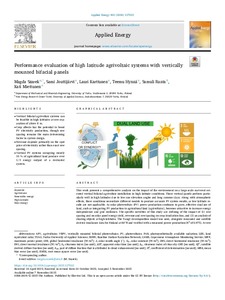
This work presents a comprehensive analysis on the impact of the environment on a large-scale east-west oriented vertical bifacial agrivoltaic installation in high latitude conditions. These vertical panels perform particularly well in high latitudes due to low sun elevation angles and long summer days. Along with atmospheric effects, these conditions necessitate different models to produce accurate PV system results, as low latitude results are not applicable. As solar photovoltaic (PV) power production continues to grow, effective dual use of land, such as integrating PV production to agricultural land (agrivoltaics), becomes attractive to increase energy independence and grid resilience. The specific novelties of this study are defining of the impact of (1) row spacing and on solar panel energy yield, revenue and row spacing on crop irradiation loss, and (2) an analysis of shading objects at high latitudes. The Yang2 decomposition model was used, alongside measured and satellite derived irradiance data for Finland at 60°N and verified with a measured power production (R2 of 0.975). At row separation of 10 m equivalent to 10 % land coverage, crops received 79.9–82.5 % irradiance compared with an unshaded reference. Energy output was 276–280 kWh and revenues 13.04–13.25 EUR per panel (2019). The variation comes from different crops, winter barley cultivation resulted in the highest energy yield and revenue. These yields were achieved using only a fraction of the land leaving the rest for agriculture, highlighting the potential of vertical agrivoltaic installations in high latitude locations.
Kokoelmat
- Rinnakkaistallenteet [29335]