Dissecting the polygenic basis of atherosclerosis via disease-associated cell state signatures
Örd Tiit; Lönnberg Tapio; Nurminen Valtteri; Ravindran Aarthi; Niskanen Henri; Kiema Miika; Õunap Kadri; Maria Maleeha; Moreau Pierre R; Mishra Pashupati P; Palani Senthil; Virta Jenni; Liljenbäck Heidi; Aavik Einari; Roivainen Anne; Ylä-Herttuala Seppo; Laakkonen Johanna P; Lehtimäki Terho; Kaikkonen Minna U
Dissecting the polygenic basis of atherosclerosis via disease-associated cell state signatures
Cell Press
Julkaisun pysyvä osoite on:
https://urn.fi/URN:NBN:fi-fe2023051744774
https://urn.fi/URN:NBN:fi-fe2023051744774
Tiivistelmä
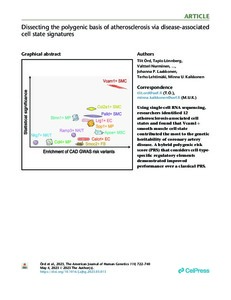
Coronary artery disease (CAD) is a pandemic disease where up to half of the risk is explained by genetic factors. Advanced insights into the genetic basis of CAD require deeper understanding of the contributions of different cell types, molecular pathways, and genes to disease heritability. Here, we investigate the biological diversity of atherosclerosis-associated cell states and interrogate their contribution to the genetic risk of CAD by using single-cell and bulk RNA sequencing (RNA-seq) of mouse and human lesions. We identified 12 disease-associated cell states that we characterized further by gene set functional profiling, ligand-receptor prediction, and transcription factor inference. Importantly, Vcam1+ smooth muscle cell state genes contributed most to SNP-based heritability of CAD. In line with this, genetic variants near smooth muscle cell state genes and regulatory elements explained the largest fraction of CAD-risk variance between individuals. Using this information for variant prioritization, we derived a hybrid polygenic risk score (PRS) that demonstrated improved performance over a classical PRS. Our results provide insights into the biological mechanisms associated with CAD risk, which could make a promising contribution to precision medicine and tailored therapeutic interventions in the future.
Kokoelmat
- Rinnakkaistallenteet [29335]