Multi-omics analysis reveals the attenuation of the interferon pathway as a driver of chemo-refractory ovarian cancer
Afenteva, Daria; Yu, Rong; Rajavuori, Anna; Salvadores, Marina; Launonen, Inga-Maria; Lavikka, Kari; Zhang, Kaiyang; Pirttikoski, Anna; Marchi, Giovanni; Jamalzadeh, Sanaz; Isoviita, Veli-Matti; Li, Yilin; Micoli, Giulia; Erkan, Erdogan Pekcan; Falco, Matias M.; Ungureanu, Daniela; Lahtinen, Alexandra; Oikkonen, Jaana; Hietanen, Sakari; Vähärautio, Anna; Sur, Inderpreet; Virtanen, Anni; Färkkilä, Anniina; Hynninen, Johanna; Muranen, Taru A.; Taipale, Jussi; Hautaniemi, Sampsa
https://urn.fi/URN:NBN:fi-fe202601217048
Tiivistelmä
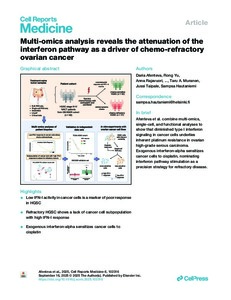
Ovarian high-grade serous carcinoma (HGSC) is one of the deadliest gynecological malignancies, with 10%–15% of patients exhibiting primary resistance to first-line chemotherapy. To characterize the molecular drivers of chemo-refractoriness, we perform multi-omics profiling of treatment-naive biopsies from patients with refractory HGSC enrolled in the DECIDER observational trial. We demonstrate that chemo-refractory HGSC is characterized by diminished interferon type I (IFN-I) and enhanced hypoxia pathway activity, and baseline IFN-I activity in chemo-naive cancer is an independent prognostic factor. Single-cell RNA sequencing and spatial protein profiling analyses corroborate the importance of elevated IFN-I activity in response to chemotherapy. Importantly, in vitro experiments demonstrate that high levels of IFN-I signaling increase cell chemosensitivity to platinum in a cell-autonomous manner. Together, these findings indicate that the IFN-I pathway activity in HGSC cancer cells predicts response to first-line chemotherapy in HGSC, proposing the stimulation of the IFN-I response as a therapeutic strategy. The study is registered at ClinicalTrials.gov (NCT04846933).
Kokoelmat
- Rinnakkaistallenteet [29335]